
CPT 92507 Is Being Replaced: What New SLPs Need to Know About the 2027 Treatment Codes
On January 1, 2027, one untimed code becomes ten timed codes. How the new codes work, how to count minutes, and what to check before the switch.
If you've billed a single individual treatment session, you've probably used CPT code 92507. It has been the go-to code for individual speech, language, voice, communication, and auditory processing treatment for more than two decades.
After this year, that changes. CPT code 92507 is deleted after December 31, 2026. Starting January 1, 2027, it's replaced by a family of 10 timed codes organized by what you're treating (ASHA, n.d.-a).
Reactions across the field have been mixed, especially around payment for shorter sessions and Medicare's proposed pediatric code. Those concerns are valid, and time will tell how it all plays out. In the meantime, here's how the new codes work and what to check before January.
Why 92507 is being replaced
According to ASHA, CMS and the AMA flagged 92507 in 2024 after Medicare billing for it grew substantially. That triggered a full review through the AMA's CPT and RUC processes. ASHA worked with practicing SLPs and clinical experts to build a replacement, and the AMA CPT Editorial Panel approved the new code family (ASHA, n.d.-a).
ASHA's stated reason is that one broad, untimed code no longer met current CPT standards for specificity (ASHA, n.d.-a). The new codes describe what you treated and how long you treated it.
The 10 new codes
There are five clinical categories. Each one has a base code for the first 30 minutes and an add-on code for each additional 15 minutes (ASHA, n.d.-a, n.d.-b).
| Clinical category | Examples | Base code (initial 30 min) | Add-on (each additional 15 min) |
|---|---|---|---|
| Fluency | Stuttering, cluttering | 92654 | +92655 |
| Speech sound production | Articulation, phonological, apraxia, dysarthria | 92656 | +92657 |
| Language comprehension and expression | Receptive and expressive language | 92658 | +92659 |
| Combined speech sound + language | Articulation and language in the same session | 92660 | +92661 |
| Voice, upper airway, and/or resonance | Vocal nodules, vocal fold paralysis, inducible laryngeal obstruction | 92662 | +92663 |
Before you load these into your billing system: confirm them against the official 2027 CPT® code set (ASHA, n.d.-b). You may still see placeholder numbers like "92X0X" in older articles; those were used before the AMA published the final codes.
Group treatment: CPT 92508 stays as an untimed code for groups of 2 or more. The difference is that it now stands on its own instead of being tied to the individual code (ASHA, n.d.-a).
Rule #1: Speech + language = the combined code
This rule is easy to miss.
If you treat both speech sound production and language in the same session, you don't bill the speech code plus the language code. You bill the combined code (92660, plus 92661 for extra time). And you never bill the combined code alongside the separate speech or language codes (ASHA, n.d.-a).
Think of a preschooler with a phonological disorder and a language delay, or an adult with dysarthria and aphasia. Both areas in one session means one combined code.
Other categories can be billed on the same day, as long as each service is distinct, medically necessary, and meets its own time requirement. For example, speech sound treatment and voice treatment in one visit can each be reported, if your notes show the goals and the minutes for each (ASHA, n.d.-a).
Rule #2: Count your minutes
92507 was billed once per session, no matter how long it was. The new codes are based on direct, one-on-one patient contact time (ASHA, n.d.-a).
Under the general CPT midpoint rule, here's how time turns into codes (ASHA, n.d.-a):
| Direct treatment time | What you report |
|---|---|
| Less than 16 minutes | Not reported separately |
| 16–37 minutes | 1 base code |
| 38–52 minutes | 1 base code + 1 add-on |
| 53–67 minutes | 1 base code + 2 add-ons |
| 68–82 minutes | 1 base code + 3 add-ons |
Two quick examples:
- A 55-minute language session: 92658 ×1 + 92659 ×2. After the first 45 minutes, the last 10 minutes pass the midpoint of the next 15-minute block (ASHA, n.d.-a).
- A 48-minute language session: 92658 ×1 + 92659 ×1. The extra 3 minutes aren't enough for a second add-on (ASHA, n.d.-a).
Another example: say you spend 20 minutes on language and 12 minutes on fluency in the same visit. The language time meets the 16-minute minimum for its base code. The fluency time doesn't. You can't pool minutes across categories, and the same minutes can't count toward two codes.
Heads-up: the midpoint rule is the general CPT convention. Medicare, Medicaid, and private plans can set different time rules, so check each payer's billing policy before you submit (ASHA, n.d.-a).
What this means for your notes
Because the codes are timed, notes need more detail than "session completed." For every session, your documentation should show:
Which service you provided (fluency, speech sound, language, combined, or voice)
The goals you addressed
Your direct treatment minutes for each service you bill Time spent on a different service, or on an untimed service, can't be counted toward these codes (ASHA, n.d.-a). So if your note template doesn't have a place for minutes, now is the time to add one.
Minutes are easiest to record accurately during or right after the session.
Using dictation? If you dictate your SOAP notes with our HIPAA-compliant SLPeaceBot®, just say the service category and your direct minutes as part of your note, for example: "Language treatment, 40 minutes direct; targeted following two-step directions." That way the details billing needs are in the note from the start, and you can check them before you sign.
Medicare, Medicaid, and everyone else
The codes are approved. Medicare payment is not final yet.
Medicare: CMS proposed payment for all 10 codes in July 2026 and accepted the values ASHA and the RUC recommended. The proposed national Medicare payments for the base codes range from about $50 to $72, and the add-ons from about $23 to $28. These are proposed, Medicare-only, and vary by location. The final rule is expected in early November 2026 (ASHA, 2026a; ASHA, 2026b).
A proposed pediatric Medicare code, GSLPP: CMS also proposed a separate, untimed Medicare code for pediatric speech-language treatment, valued like 92507. ASHA did not request it and has submitted comments on it. It is a proposal only and may change in the final rule (ASHA, 2026a).
Medicaid and private insurance: these payers don't have to adopt the new codes or Medicare's rates on January 1. Some may keep accepting 92507 for a while; others may switch right away (ASHA, n.d.-a; ASHA, 2026a).
Telehealth: ASHA has asked CMS to add the new codes to Medicare's telehealth services list (ASHA, 2026b). If you see Medicare patients by telehealth, check the final rule for this.
Bottom line: keep billing 92507 through December 31, 2026. Don't use the new codes before January 1, 2027. And confirm each payer's start date before you switch (ASHA, n.d.-a).
Free tools to keep track
Nobody wants to do minute math between sessions. We made three free SLPeace® tools so you don't have to remember the thresholds or add things up in your head.
1. Session Time Calculator (Google Sheets)
Type the start and end time for each part of the session and pick the area from a dropdown. The sheet works out the minutes, adds them up by area, and shows what to bill. A Check column next to each line flags problems as you type.
👉 Make your own free copy of the calculator
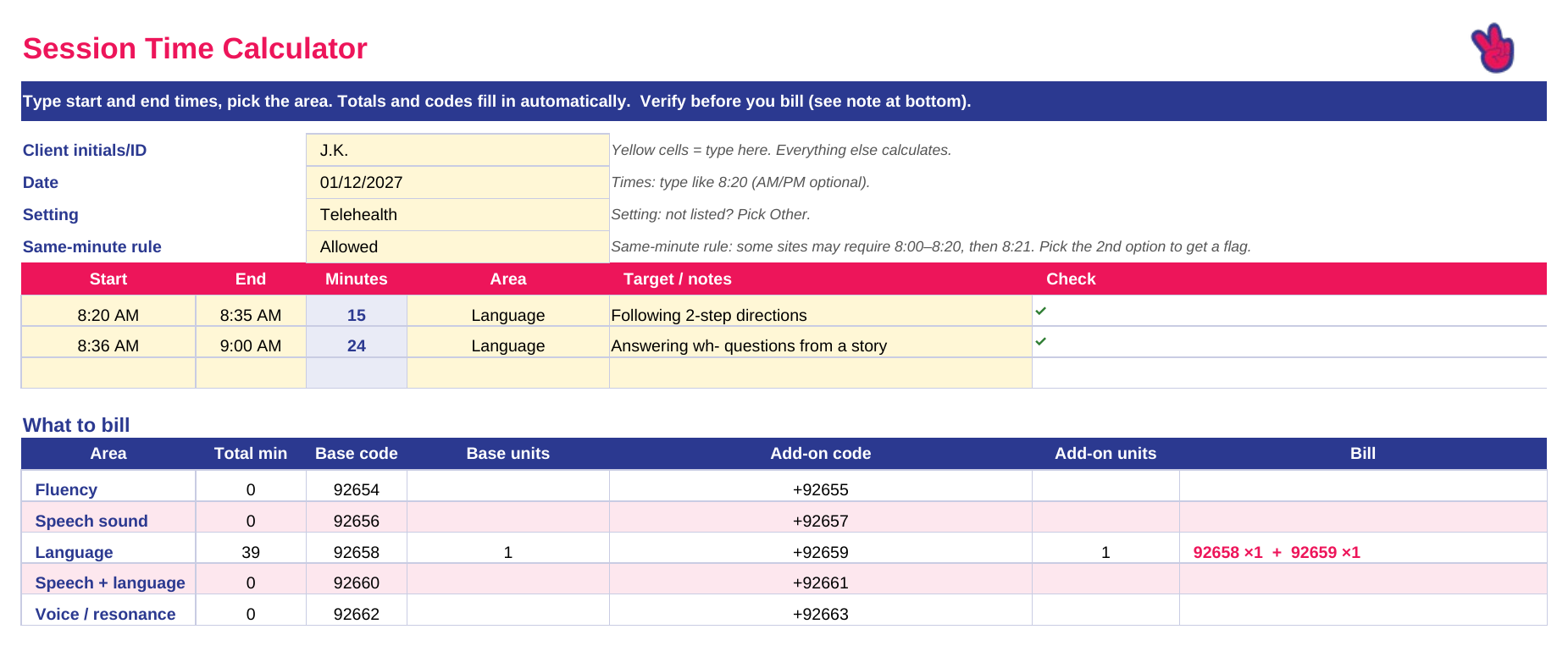
Here's what it looks like with real sessions:
A language session split into two chunks
| Start | End | Area | Minutes |
|---|---|---|---|
| 8:20 | 8:35 | Language | 15 |
| 8:36 | 9:00 | Language | 24 |
The calculator adds the two lines to 39 minutes of language and shows 92658 ×1 + 92659 ×1. Both lines show a green ✓.
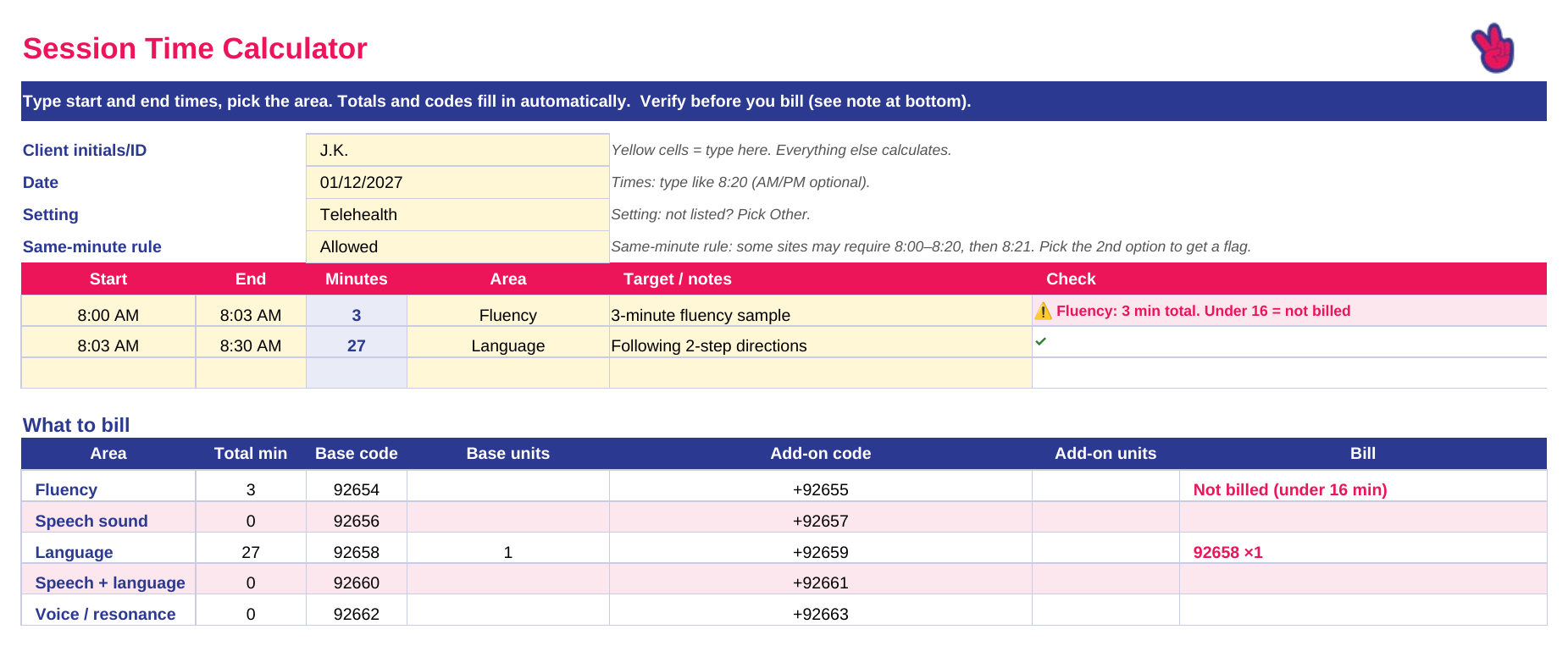
A quick fluency sample
You take a 3-minute fluency sample (8:00 to 8:03). The Check column turns pink: "⚠ Fluency: 3 min total. Under 16 = not billed." That's your cue to document it in the note without billing a fluency code.
Articulation and language logged separately
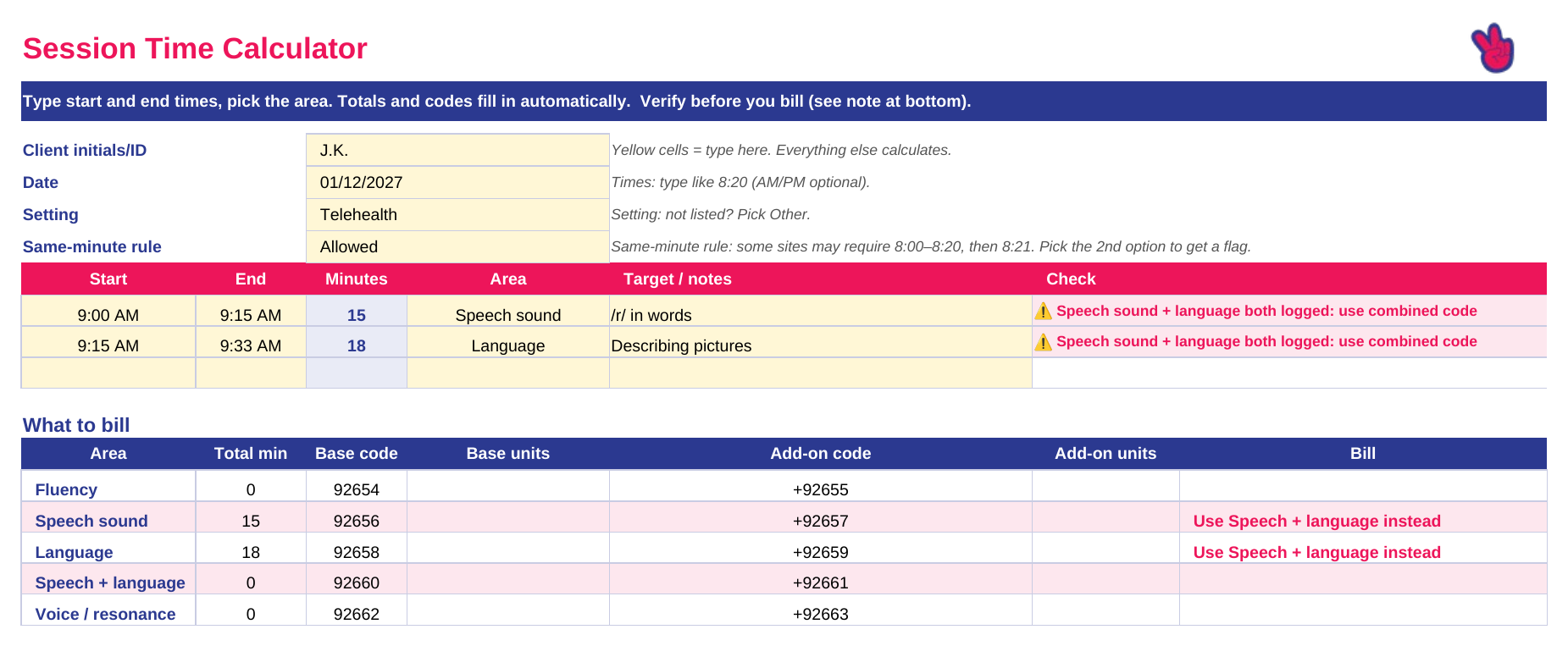
You log 15 minutes of speech sound and 18 minutes of language. Both lines flag: "⚠ Speech sound + language both logged: use combined code."
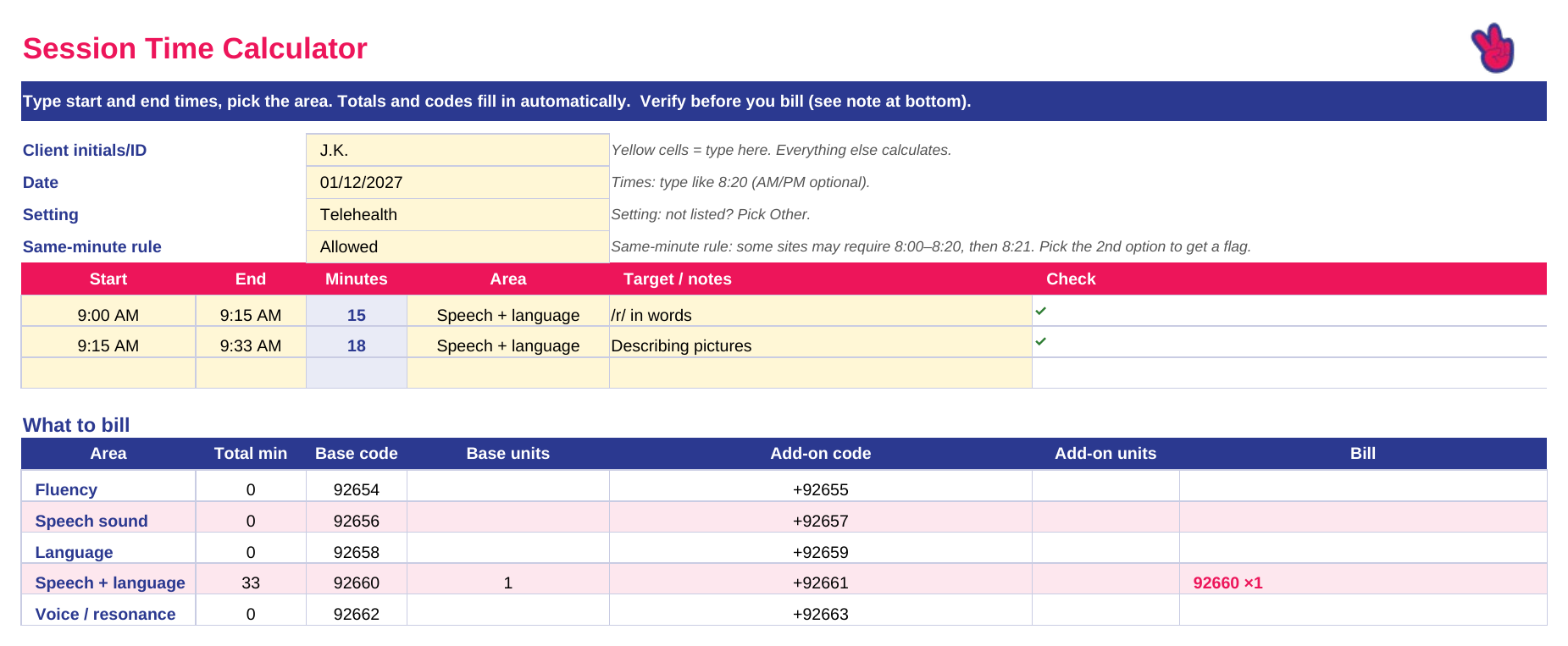
Change both lines to Speech + language, and the sheet shows 92660 ×1 for 33 minutes.
Typos
The sheet also catches a missing end time, 0 minutes, a line with no area picked, a line over 2 hours, and two lines with overlapping times (the same minutes can't count twice).
Same-minute rule
Some sites and payers don't let one line end and the next start on the same minute. They want 8:00–8:20, then 8:21. If that's your rule, set Same-minute rule to Next line starts 1 min later, and the sheet will flag any line that starts the minute another one ends.
2. Session Time Tracker (printable)
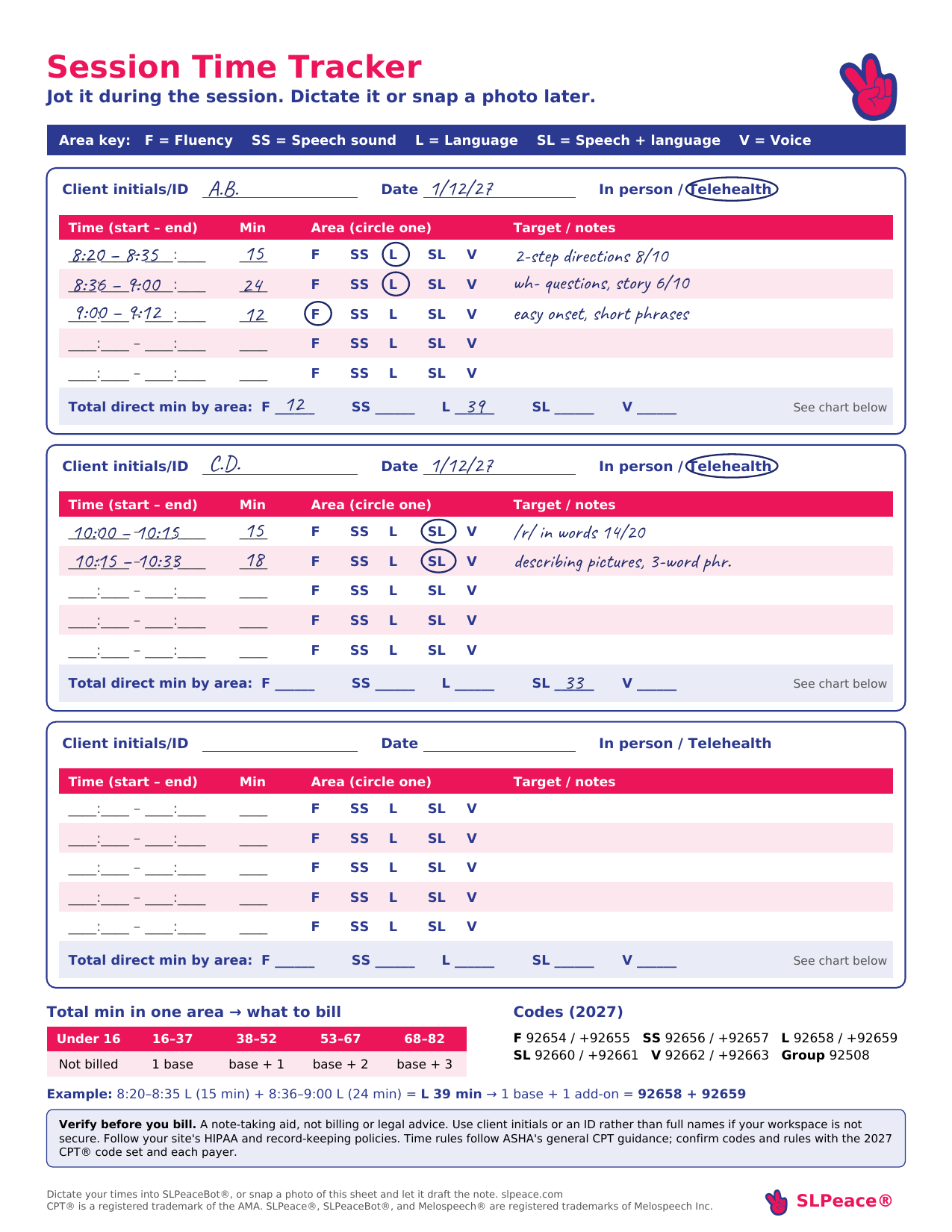
Prefer paper? The tracker has three session blocks per page. Jot each time chunk as you go (like 8:20–8:35, L, following directions), circle the area, and add up the minutes at the end. A chart at the bottom shows what each total bills as, so you don't have to remember the 16, 38, 53, and 68-minute marks.
👉 Download the free tracker (PDF)
3. Cheat sheet and FAQ
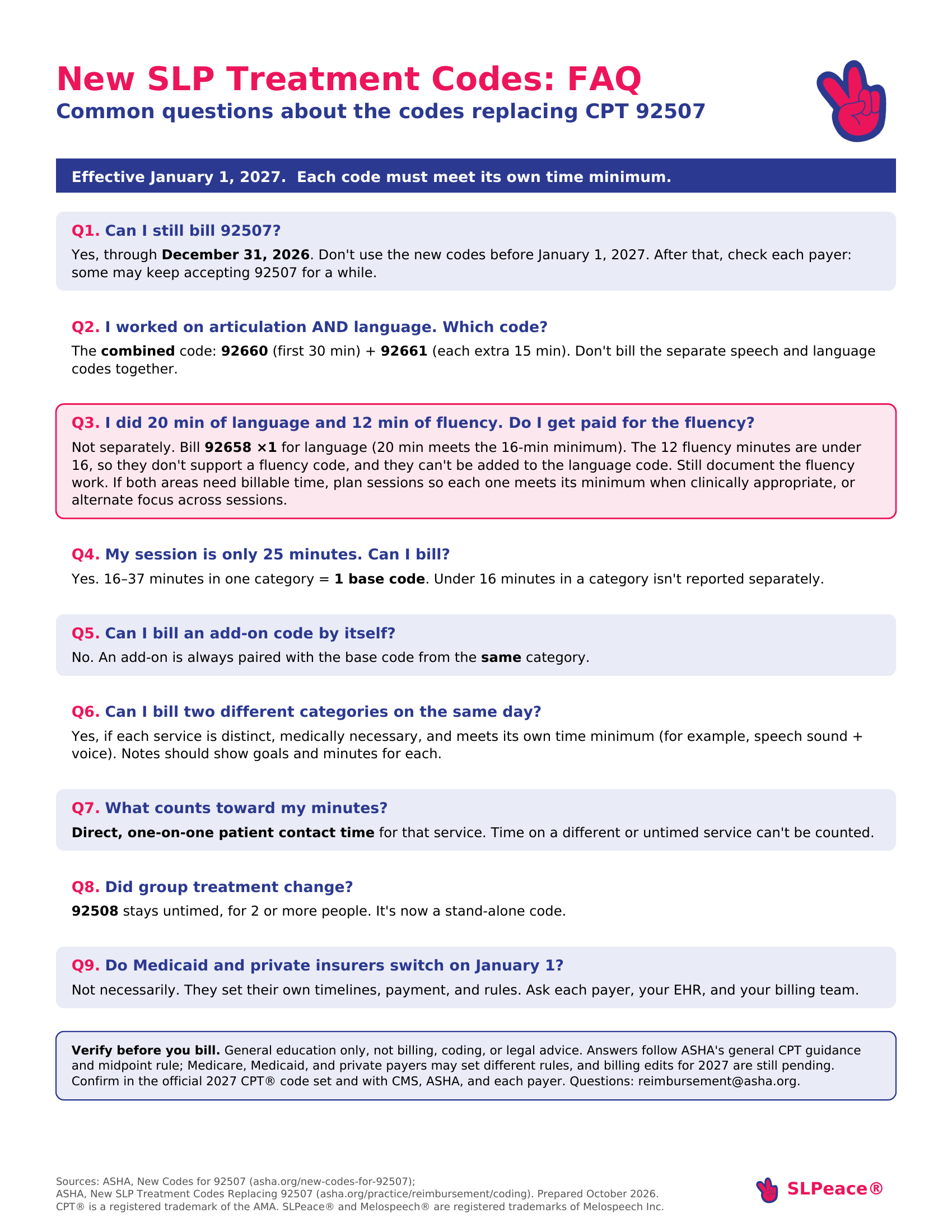
Keep the one-page cheat sheet by your desk for the codes and the time chart. The FAQ covers the questions we hear most, like "I did 20 minutes of language and 12 of fluency. Do I get paid for the fluency?"
👉 Download the free cheat sheet (PDF)
The calculator, tracker, and cheat sheet are note-taking aids, not billing or legal advice. Use client initials or an ID rather than full names if your workspace is not secure, and follow your site's HIPAA and record-keeping policies.
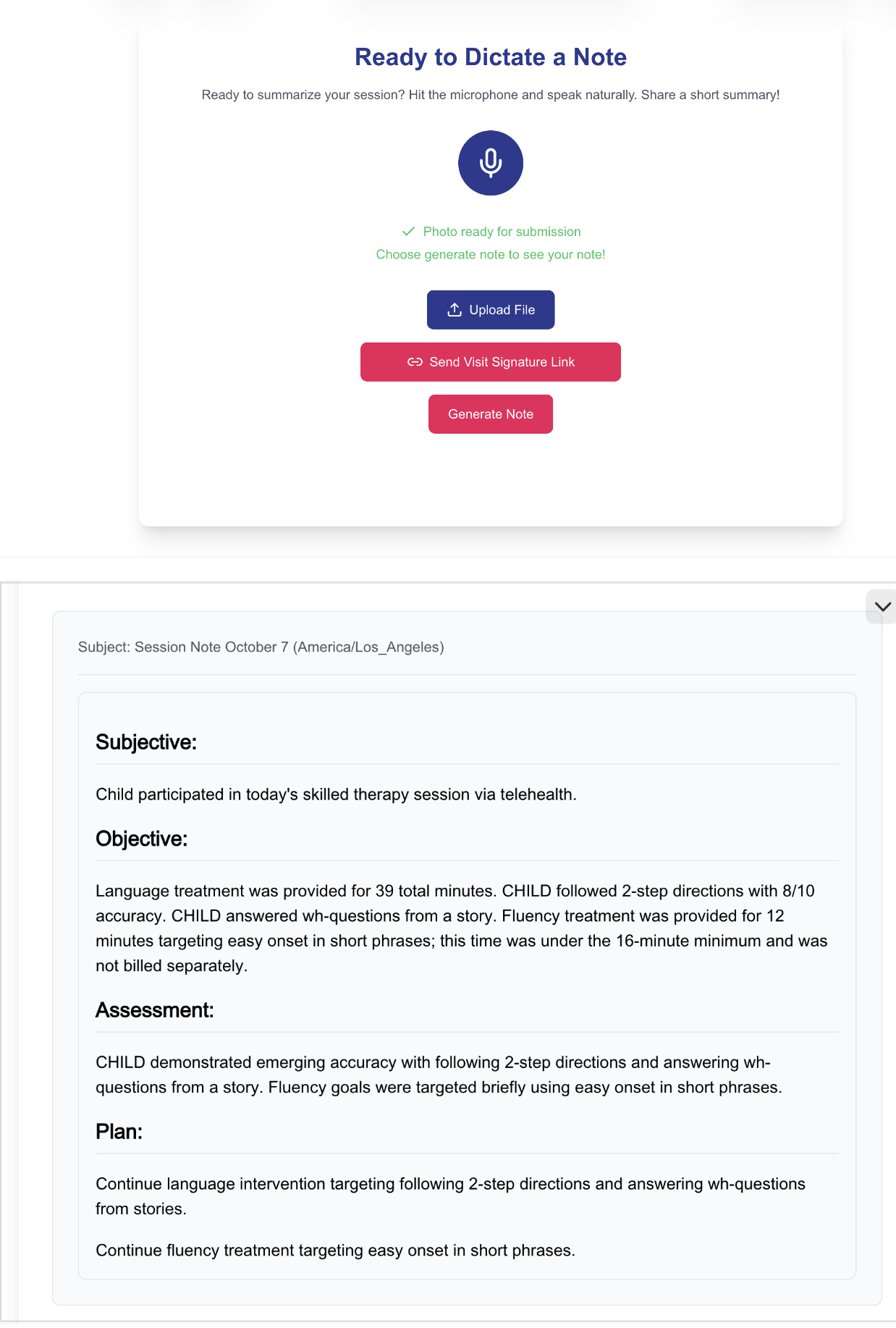
From tracker to note: dictate your times and areas into SLPeaceBot®, or snap a photo of your paper tracker (one session at a time) or calculator and let SLPeaceBot® draft the full note. Here's the note it drafted from a photo of the calculator's Example tab. It kept the 39 minutes of language and noted that the 12 minutes of fluency were under the 16-minute minimum and not billed separately.
Your to-do list before January 1
Even if someone else handles billing, your notes are what billing relies on.
✅ Learn the five categories and the combined-code rule
✅ Start tracking direct minutes now, even though 92507 doesn't require it yet. The habit will be automatic by January
✅ Update your note template with a service category and minutes for each code
✅ Ask your EHR or billing platform when the new codes will be loaded
✅ Ask your billing team or contracting agency which payers are switching on January 1 and which aren't
✅ Use ASHA's free transition resources: a template letter to payers, a coding readiness checklist, a payer code tracker, a quick guide, and code-by-code videos (ASHA resources)
✅ Attending ASHA Convention? ASHA is holding an in-person CPT code workshop for SLPs on Wednesday, November 18, 2026, 5:30–7:30 p.m. ET, at the JW Marriott Indianapolis (details)
✅ Check any contract that names 92507 by number
✅ Grab the free tools above: the calculator, the printable tracker, and the cheat sheet
✅ Watch for the Medicare final rule in early November
Questions? ASHA's health care education and policy team answers coding questions at reimbursement@asha.org (ASHA, n.d.-a).
Track your minutes, document right away, and check back as payers announce their plans. Because every SLP deserves a little peace.®
This post is general information, not billing or legal advice. Code numbers, payment amounts, and payer rules can change. Always confirm with the official 2027 CPT code set, CMS, and each payer. CPT® is a registered trademark of the American Medical Association. SLPeace®, SLPeaceBot®, Melospeech®, and "Because every SLP deserves a little peace.®" are registered trademarks of Melospeech Inc.
References
American Speech-Language-Hearing Association. (n.d.-a). New speech-language pathology treatment codes replacing 92507. https://www.asha.org/practice/reimbursement/coding/new-speech-language-pathology-treatment-codes-replacing-92507/
American Speech-Language-Hearing Association. (n.d.-b). New codes for 92507. https://www.asha.org/new-codes-for-92507
American Speech-Language-Hearing Association. (2026a, July 15). CMS proposes Medicare payment for new speech-language pathology treatment codes. https://www.asha.org/news/2026/cms-proposes-medicare-payment-for-new-speech-language-pathology-treatment-codes/
American Speech-Language-Hearing Association. (2026b, July 24). 2027 Medicare Part B proposed rule: Coding, payment, and policy analysis. https://www.asha.org/news/2026/2027-medicare-part-b-proposed-rule-coding-payment-and-policy-analysis/
About the author
- We are SLPs, SLPAs, OTs, COTAs, and Educators!
Comments
Join the discussionNo comments yet. Be the first to comment.