
The Zero-Equipment Voice Protocol: A Ready-to-Use CAPE-Vr Guide for SLPs
How to run the CAPE-Vr when you only have access to a free form, a quiet room, and your ears
At one point, Melospeech® specialized in several areas, including voice therapy. One thing we learned quickly: it helps to have a go-to voice protocol you can run anywhere, whether you're on the road doing home health or treating voice through telehealth.
Back then, our go-to was the CAPE-V. It has since been updated, so this guide walks you through the newest version. It uses a free, open-access form and no special equipment.
Why you need a perceptual voice tool
In home health, mobile outpatient, and telehealth settings, you rarely have acoustic analysis tools like Visi-Pitch or the Computerized Speech Lab (CSL) on hand.
You still need a standardized way to describe voice quality, document baseline severity, and track treatment outcomes.
That's where the Consensus Auditory-Perceptual Evaluation of Voice (CAPE-V) comes in. It was developed through ASHA's Special Interest Division 3 after a 2002 consensus conference, and it's often considered the gold standard for auditory-perceptual voice evaluation (Kempster et al., 2009; Kempster et al., 2025).
In 2025, the CAPE-V got its first major update: the CAPE-V Revised (CAPE-Vr). It keeps the original's purpose but is simpler to give and score, and it was built with virtual and unrecorded sessions in mind (Kempster et al., 2025). It isn't the version we used in our voice work, but if you're learning the tool now, this is the one to learn.
Note that this is a perceptual evaluation, not a stand-alone diagnostic tool. It should be one part of a full voice assessment, not the only tool you use to decide the nature of a voice disorder (ASHA, 2002/2009).
Get the free form
The CAPE-Vr is open access. Download the printable form here:
👉 Download the CAPE-Vr form (PDF)
Form © 2025 Kempster, Nagle & Solomon, published open access under CC BY 4.0 with their article in the Journal of Voice. Shared unchanged.
📊 Get the free CAPE-Vr Progress Tracker (Google Sheet): our companion log for your ratings. It calculates change from baseline for each attribute and charts progress across sessions. It doesn't replace the official form; rate on the form, then log your numbers here.
📖 For the full instructions and the reasons behind each change, see Table 1 in the open-access CAPE-Vr article.
Printing tip: The rating lines only score correctly if each one is exactly 100 mm. After printing, measure one. If it isn't 100 mm, write the actual length on the form, then divide each measurement by that length and multiply by 100 (Kempster et al., 2025).
Before you start: set up and note your conditions
Seat the client comfortably in a quiet room. Place your microphone or device at a fixed distance from their mouth and record the session (Kempster et al., 2025).
The CAPE-Vr form has a Recording Conditions section. Note:
whether you recorded or not
whether the session was in person or virtual
the room, the device or video platform, and the mouth-to-microphone distance
This is what makes the CAPE-Vr a good fit for home health and telehealth. You don't need lab equipment. You document what you used, so you or another clinician can set it up the same way next time.
The tasks
You can give the three main tasks in any order (Kempster et al., 2025).
1. Sustained vowels
Ask the client to say /ɑ/ ("ah") and /i/ ("ee") in their typical speaking voice, holding each for 3 to 5 seconds.
One trial of each is enough, as long as it sounds typical of the person's speaking voice.
Don't model it. Clients tend to copy your pitch and voice quality (Kempster et al., 2025).
2. Sentences
Have the client read each sentence aloud in their typical speaking voice. Each sentence targets a different feature (Kempster et al., 2025):
| Sentence | What it targets | |
|---|---|---|
| a | The blue spot is on the key again. | English corner vowels |
| b | He helped her hurry home. | Word-initial /h/ |
| c | We were away a year ago. | All voiced sounds |
| d | I eat eggs every evening. | Vowel-initial words |
| e | My mama makes lemon muffins. | Nasal consonants |
| f | Papa took a piece of the cake. | High-pressure consonants |
Print the sentences in a large, easy-to-read font. If the client has trouble reading, you can model each sentence, and check the box on the form to show you did.
Telehealth tip: Screen-share the sentences in large, bold text, one at a time.
3. Extemporaneous speech
Get at least 20 seconds of natural speech with this prompt:
"Tell me about a place you have gone or would like to go."
The old CAPE-V prompt was "Tell me about your voice problem." The change is deliberate: it keeps the sample from revealing the voice concern to whoever rates the recording, and it works for clients with no voice complaint at all (Kempster et al., 2025). Any other prompt that isn't about voice is also acceptable.
Optional: reading passage
If you also use a reading passage, such as the first paragraph of the Rainbow Passage, note it on the form (Kempster et al., 2025).
How to score
Rate from the recording
Ratings are meant to be made from the recording. If you rate live instead, mark that on the form. Listen as many times as you need, and note:
how many times you played the samples
headphones or speakers
whether you used reference voice samples as anchors
who rated it and when
(Kempster et al., 2025)
Four attributes on the 100 mm lines
| Attribute | Definition |
|---|---|
| Overall Severity | Global, integrated impression of how far the voice deviates from normal |
| Roughness | Perceived irregularity in the voicing source |
| Breathiness | Perceived air escape in the voice |
| Strain | Perceived vocal effort, tension, or press |
(Kempster et al., 2025)
"Normal" is printed above the left end of the lines and "Extreme" above the right. Make a small tick mark anywhere on each line. Then measure in millimeters from the left end to your mark and write the number in the blank, for example, Roughness 56/100.
There's one blank line if you want to rate another attribute.
Everything else: circle what you hear
These are rated with categories, not lines (Kempster et al., 2025):
| Feature | Options |
|---|---|
| Pitch (average) | Normal, Low, High |
| Loudness (average) | Normal, Quiet, Loud |
| Resonance | Normal, Front ("in the mask"), Back (pharyngeal, "throaty") |
| Nasality | Normal, Hyponasal, Hypernasal |
| Inconsistencies | None, or Present with a description by task |
| Instabilities | Circle any that apply, or add your own term |
| Additional features | Circle any that apply, or add your own term |
Finish with your Overall Impression: the overall severity in a few words, plus the voice's most prominent features.
Getting reliable ratings without a lab
Rater agreement on perceptual voice scales has always varied widely (ASHA, 2002/2009). Three habits help:
Keep your setup the same. Use the same device, room, and mouth-to-microphone distance at every visit when you can, so recordings are comparable over time (Kempster et al., 2025).
Compare to baseline. At follow-up visits, listen to the earlier recording next to the new one, with the earlier form in front of you (ASHA, 2002/2009).
Practical tip for video calls: if your platform has noise suppression or "voice enhancement" settings, consider turning them off. They're designed to clean up audio, which may soften the very qualities you're rating.
Still seeing the original CAPE-V?
You will. It's what most grad programs taught, what most textbooks print, and what's in a lot of existing client files. Here's what's different in the original (ASHA, 2002/2009; Kempster et al., 2025):
Three vowel trials instead of one
Different sentences b, d, and f: "How hard did he hit him?", "We eat eggs every Easter," and "Peter will keep at the peak"
The prompt "Tell me about your voice problem"
Pitch and loudness rated on 100 mm lines, with the direction written in
"MI / MO / SE" severity labels under each line. These were dropped partly because two versions of the form placed them in different spots.
A C (consistent) or I (intermittent) mark next to every scale, instead of one Inconsistencies section
Whichever version you use, use the same one every time with the same client. Switching versions makes progress hard to compare. If a client's baseline was done on the original CAPE-V, keep re-rating them on the original.
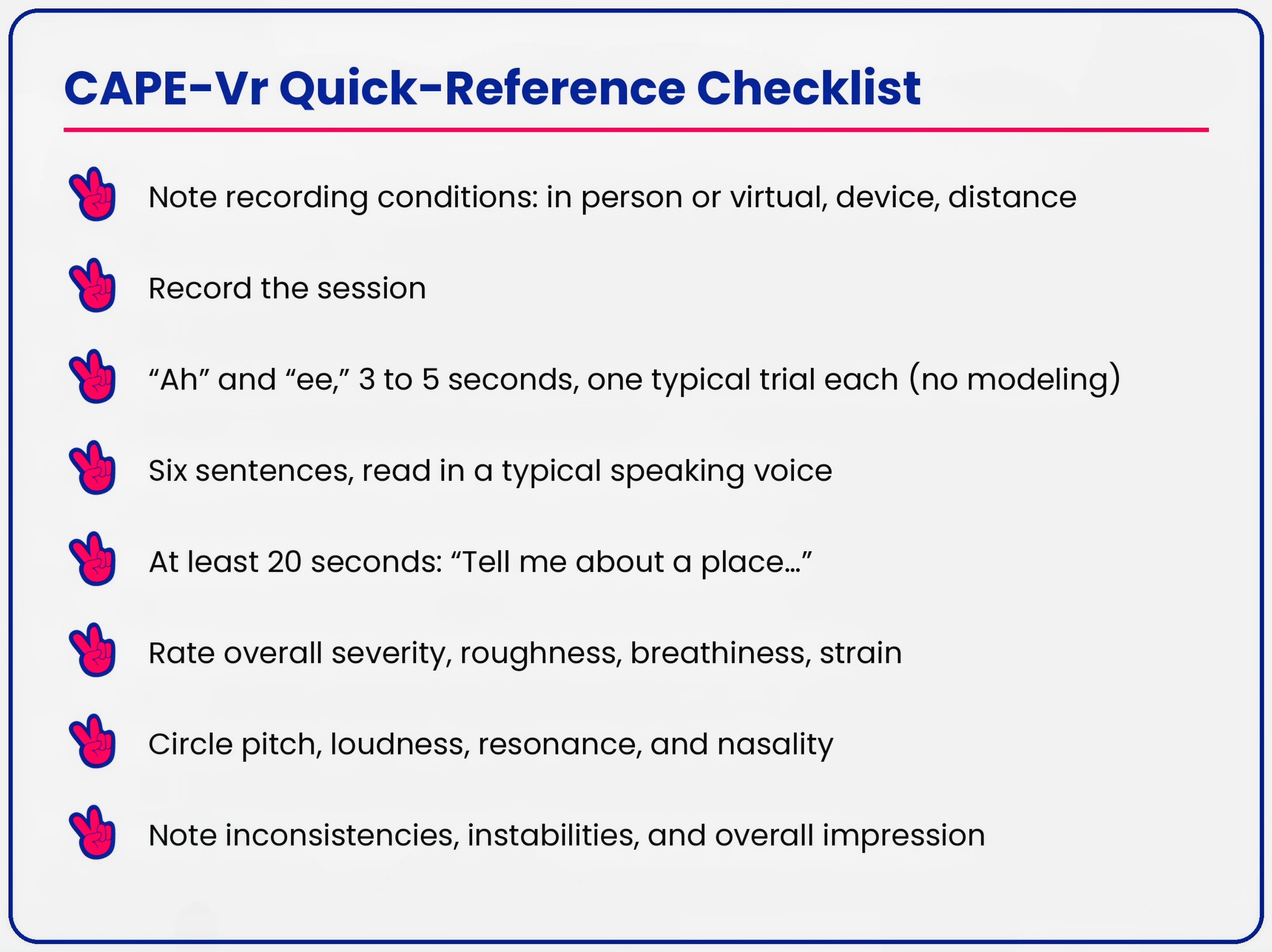
Quick-reference checklist
References
American Speech-Language-Hearing Association. (2002/2009). Consensus auditory-perceptual evaluation of voice (CAPE-V). ASHA Special Interest Group 3, Voice and Voice Disorders. https://resources.finalsite.net/images/v1693231587/resanet/djvm3pfoizvmmqaydzx9/cape-v-procedures-and-form.pdf
Kempster, G. B., Gerratt, B. R., Verdolini Abbott, K., Barkmeier-Kraemer, J., & Hillman, R. E. (2009). Consensus auditory-perceptual evaluation of voice: Development of a standardized clinical protocol. American Journal of Speech-Language Pathology, 18(2), 124–132. https://doi.org/10.1044/1058-0360(2008/08-0017)
Kempster, G. B., Nagle, K. F., & Solomon, N. P. (2025). Development and rationale for the Consensus Auditory-Perceptual Evaluation of Voice–Revised (CAPE-Vr). Journal of Voice. Advance online publication. https://doi.org/10.1016/j.jvoice.2025.01.022
About the author
- We are SLPs, SLPAs, OTs, COTAs, and Educators!